CCM Versus Transitional Care for Medicare
A Medicare patient discharged after heart failure, COPD exacerbation, or uncontrolled diabetes does not stop needing care when they leave the hospital. The question for a practice is whether CCM versus transitional care is the right service model for that patient, that moment, and the workflow your team can support.
The answer is not either-or. Transitional Care Management (TCM) is designed for the high-risk period immediately after discharge. Chronic Care Management (CCM) supports patients with ongoing, long-term clinical needs. Practices that understand the distinction can close care gaps, reduce preventable utilization, and capture appropriate Medicare reimbursement without forcing providers or front-desk staff to carry another administrative burden.
CCM Versus Transitional Care: The Core Difference
CCM is a monthly care-management service for Medicare beneficiaries with two or more chronic conditions expected to last at least 12 months, or until death. Those conditions must place the patient at significant risk of death, acute exacerbation, functional decline, or decompensation. Diabetes, hypertension, heart failure, COPD, chronic kidney disease, depression, and dementia are common examples.
The focus is longitudinal. CCM creates an ongoing structure for medication support, care-plan maintenance, coordination among clinicians, symptom follow-up, and patient engagement. It is built for patients whose health needs do not disappear after a single office visit.
TCM is different. It addresses the transition from a qualifying inpatient or facility-based setting back to the community. The service begins on the date of discharge and continues for 29 days. It is intended to reduce the risk that a patient leaves a hospital or post-acute setting with unanswered questions, medication errors, missed follow-up, or no coordinated plan for the next stage of care.
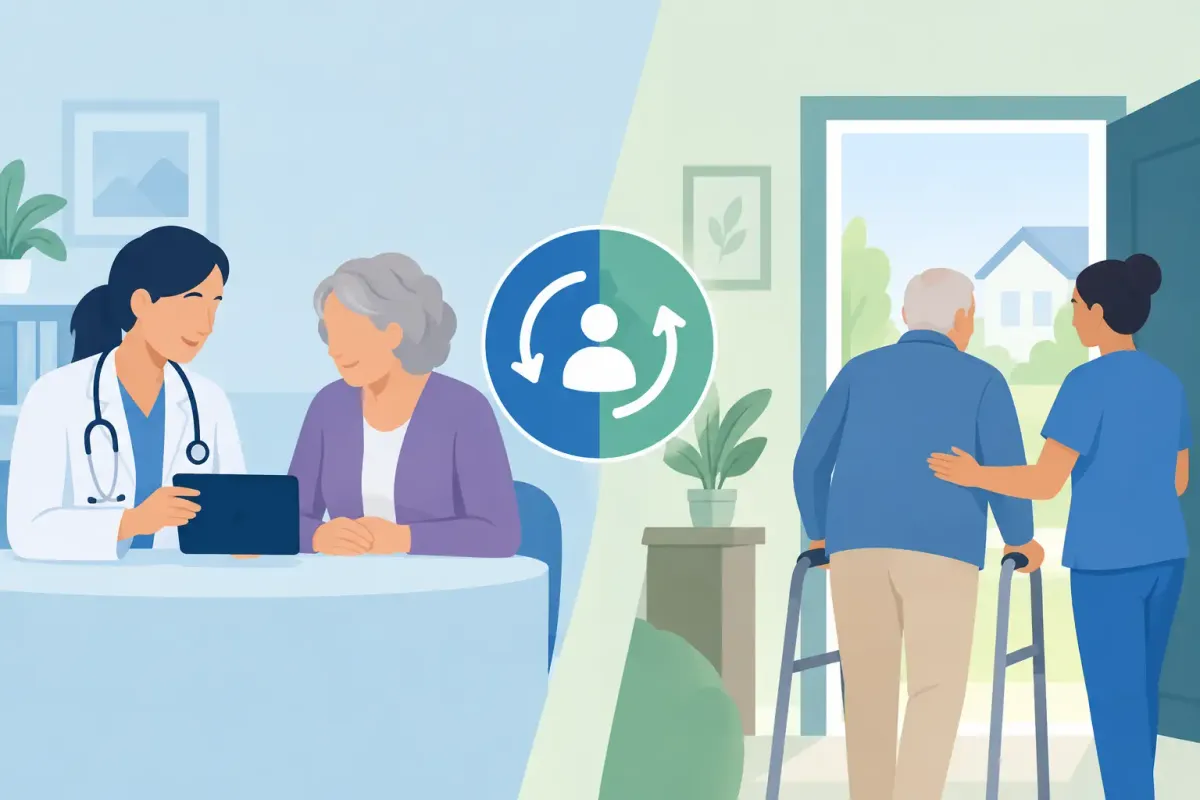
Put simply: TCM manages the immediate handoff. CCM manages the chronic condition burden that continues after the handoff.
When Transitional Care Management Applies
TCM is appropriate after discharge from a qualifying setting, such as an inpatient hospital, observation status, partial hospitalization, skilled nursing facility, inpatient rehabilitation facility, or certain outpatient observation services. The patient must return to a community setting, including home, assisted living, or another community-based residence.
The operational requirements are specific. A licensed clinical staff member or other qualified team member must make interactive contact with the patient or caregiver within two business days of discharge. That contact may occur by phone, electronic communication, or face-to-face interaction, but it must be documented.
The patient also needs a face-to-face visit with the billing practitioner. For CPT 99495, the visit must occur within 14 calendar days of discharge and involve moderate medical decision-making. For CPT 99496, the visit must occur within seven calendar days and involve high-complexity medical decision-making.
The reimbursement reflects this intensity. TCM recognizes the work of reviewing discharge information, reconciling medications, coordinating services, arranging follow-up, educating the patient or caregiver, and addressing clinical risk during the vulnerable post-discharge window.
That makes TCM valuable, but it is not a standing monthly program. Once the 29-day service period ends, the practice needs another care model if the patient still requires structured outreach and chronic-condition oversight.
When Chronic Care Management Is the Better Fit
CCM is the better fit when a patient has ongoing clinical complexity but is not necessarily coming home from a recent qualifying discharge. A primary care practice may have hundreds of Medicare beneficiaries who qualify based on multiple chronic diagnoses, medication burden, frequent specialist involvement, social barriers, or recurring symptoms.
For standard CCM, the practice generally needs documented patient consent, a comprehensive electronic care plan, 24/7 access to urgent care needs, and at least 20 minutes of qualifying clinical staff time in a calendar month. CPT 99490 is the foundational code for that initial monthly service time. Additional time may be reported when the applicable requirements are met.
The real value is not simply the monthly code. A well-run CCM program gives a practice a dependable way to identify problems before they become emergency department visits, hospitalization events, or avoidable clinical deterioration. It also gives patients a clear point of contact between appointments.
For a physician office with a large Medicare panel, CCM can become a meaningful recurring revenue line. But only if enrollment, consent, care-plan documentation, time tracking, outreach, and billing are handled consistently. A program that relies on a provider to remember every monthly requirement will not scale.
Can a Practice Use TCM and CCM for the Same Patient?
Often, yes. A patient may qualify for TCM following discharge and remain eligible for CCM because of their chronic conditions. This is where practices need operational discipline.
The services must be medically necessary, separately documented, and supported by the work performed. The practice cannot count the same clinical activity or staff time twice. It also needs to follow current Medicare rules, payer-specific edits, and billing guidance for concurrent care-management services.
A practical model is to treat TCM as the immediate stabilization period and CCM as the continuing care structure. During the post-discharge period, the team ensures timely patient contact, medication reconciliation, follow-up scheduling, and clinical escalation. Once the transition is stabilized, ongoing CCM outreach can maintain engagement around the patient’s chronic needs.
This approach is especially relevant for patients with heart failure, COPD, diabetes, hypertension, chronic kidney disease, or multiple comorbidities. Discharge may resolve the immediate episode, but it rarely resolves the underlying risk.
The Operational Trade-Offs Practices Need to Consider
TCM can produce strong reimbursement per qualifying discharge, but it is event-driven. Your team must identify discharges quickly, obtain reliable discharge information, reach the patient within the two-business-day window, and secure the required follow-up visit. If notification arrives late or ownership is unclear, the opportunity can disappear.
CCM is more predictable from a revenue standpoint because it is monthly, but it requires a sustainable operating model. The practice needs an eligible patient population, reliable patient outreach, a documented care plan, accurate time capture, and a process for escalating concerns to the provider.
Neither program should be treated as a billing exercise. If a patient cannot reach the care team, if medication issues go unresolved, or if documentation is assembled after the fact, the program creates compliance exposure without delivering the clinical result Medicare expects.
The strongest model uses defined roles. Clinical staff or care specialists conduct outreach and document qualifying work. Providers remain involved in clinical decision-making and escalation. Billing staff receive clean, timely documentation. Leadership reviews enrollment, engagement, time completion, claims performance, and patient outcomes.
A Practical Decision Framework
Start with the patient’s current status. If they were recently discharged from a qualifying facility and returned to the community, assess TCM requirements immediately. The two-business-day contact deadline is not flexible simply because the office is busy.
If the patient has two or more qualifying chronic conditions and needs ongoing support, assess CCM enrollment. This may be appropriate whether or not they had a recent discharge.
Then evaluate the practice’s capacity. Can your team consistently receive discharge notifications? Can it complete follow-up outreach, medication reconciliation, care-plan maintenance, and documentation without disrupting the schedule? If the answer is no, the clinical opportunity is still real, but the delivery model needs to change.
A turnkey care-management partner can remove much of that burden. With the right structure, practices can add care specialists, patient outreach, documentation workflows, billing support, and compliance oversight without adding equipment costs or expanding internal headcount. Practice Revenue Solutions supports this type of managed CCM model so practices can focus on patient care and clinical oversight rather than building a new administrative department.
Build the Program Around Patient Risk, Not a Code
The best starting point is a Medicare population analysis. Identify patients with multiple chronic conditions, recent utilization, high medication burden, repeated missed appointments, and limited support after discharge. Those patients are most likely to benefit clinically and most likely to expose gaps in an unstructured workflow.
From there, create a clear path: TCM for the immediate post-discharge period, CCM for recurring chronic-care needs, and provider escalation when symptoms, adherence barriers, or clinical risk require attention. That path creates a care experience patients can understand and a reimbursement process the practice can defend.
The most useful next step is not choosing a code in isolation. It is mapping where patients are falling through the cracks, then putting a compliant care-management process in place before the next discharge turns into the next avoidable crisis.
