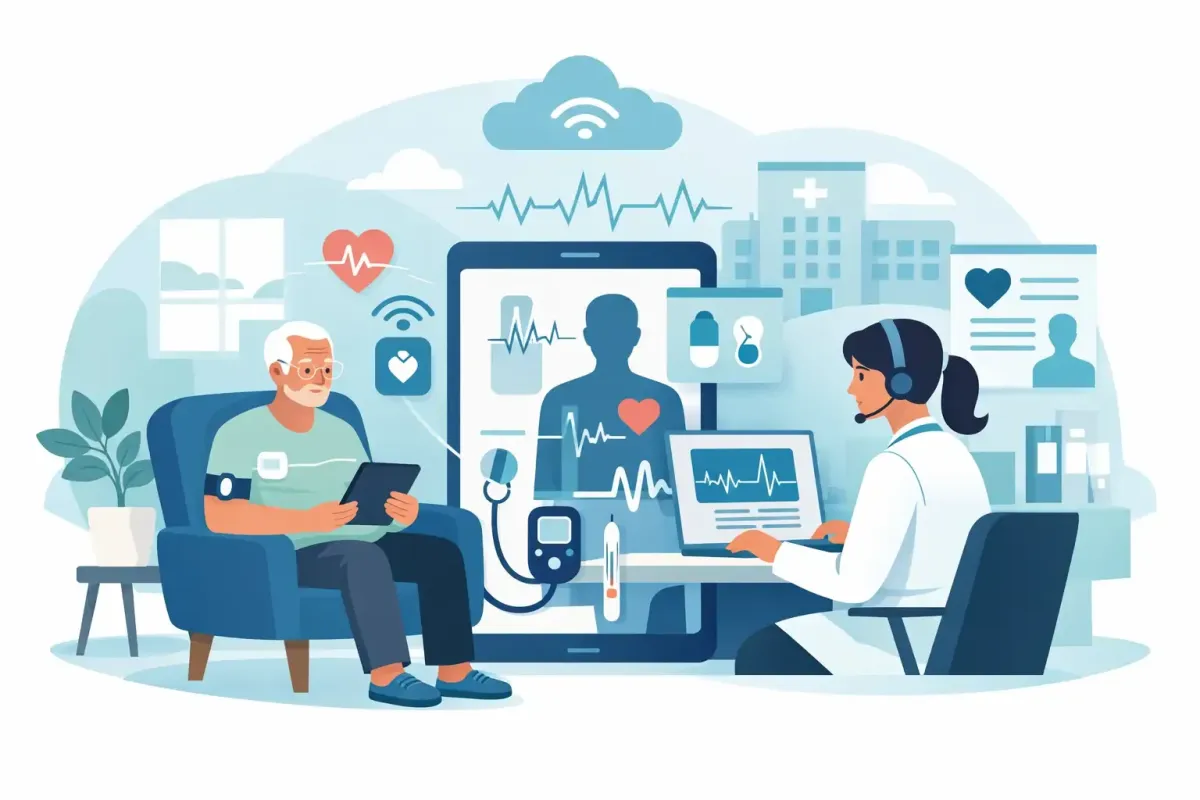
Remote Patient Monitoring Chronic Disease Management
A Medicare patient with heart failure gains five pounds in four days, but no one sees it until the next office visit. A patient with diabetes has rising glucose trends for two weeks, yet the practice only learns about the problem after an avoidable escalation. This is where remote patient monitoring chronic disease management stops being a nice idea and becomes a practical operating model.
For practices serving older adults and high-risk populations, the value is straightforward. You can monitor patients between visits, intervene earlier, document ongoing care, and create a reimbursable service line without forcing physicians and office teams to absorb more work. The real question is not whether RPM can help. It is whether your organization can implement it in a way that is clinically useful, operationally realistic, and financially worth the effort.
Why remote patient monitoring chronic disease management works
Chronic disease does not unfold on a 15-minute visit schedule. Hypertension, diabetes, CHF, COPD, and other long-term conditions change day by day, often without obvious symptoms until the patient is already in trouble. Remote monitoring closes that gap by bringing physiological data into the care process on a regular basis.
That matters clinically because trends are often more useful than snapshots. A single blood pressure reading in the office can be distorted by stress, timing, or adherence just before the appointment. A month of home readings tells a more accurate story. The same is true for weight in heart failure, pulse oximetry in COPD, or glucose values in diabetes management.
It also matters financially. Medicare reimbursement for RPM and related chronic care services gives practices a way to support higher-touch care for eligible patients. When implemented correctly, these programs can produce recurring monthly revenue tied to legitimate clinical oversight, not one-time visits or episodic billing. For organizations under margin pressure, that changes the economics of chronic care.
The operational challenge is not clinical - it is execution
Most healthcare leaders already understand the clinical case for RPM. What slows adoption is execution. Someone has to identify eligible patients, enroll them, ship or distribute devices, educate patients, monitor adherence, review incoming data, escalate concerns, document interactions, and support billing. If those tasks land on an already strained front desk, MA pool, or nursing team, the program stalls.
This is why some RPM launches underperform. The idea is solid, but the workflow is not. Device utilization drops. Documentation becomes inconsistent. Billing opportunities are missed. Providers lose confidence because the program creates more follow-up tasks than it resolves.
A strong remote patient monitoring chronic disease management program has to be designed around operational reality. That means low-friction onboarding, clear escalation protocols, dedicated monitoring support, compliance-ready documentation, and a billing structure that holds up under scrutiny. It also means leadership should be honest about trade-offs. A do-it-yourself model may preserve more direct control, but it often requires more staffing, more training, and more internal oversight. A turnkey model reduces internal burden, but the right partner matters.
Which patients benefit most
RPM is not equally effective for every panel. The strongest fit is usually Medicare patients with chronic conditions that benefit from frequent trend data and early intervention. Hypertension is a natural entry point because device adoption is relatively simple and medication adjustments can follow documented patterns. Heart failure is another high-value use case because weight changes and blood pressure shifts can signal problems early. Diabetes can work well when patient engagement is strong and the care pathway is defined.
The best candidates usually share a few characteristics. They have a documented chronic diagnosis, enough clinical risk to justify ongoing oversight, and the ability - either independently or with caregiver support - to use home devices consistently. Patients in skilled nursing, assisted living, and medically complex primary care populations often fit well, but success still depends on process.
That last point matters. A patient may be clinically eligible and still be a poor operational fit if there is no device support, no follow-up structure, or no practical way to act on the data. Enrollment volume by itself is not the goal. Sustained participation and actionable monitoring are what drive both patient value and reimbursement performance.
Revenue is real, but only if the workflow holds
Healthcare executives are right to ask hard questions about financial upside. RPM can generate meaningful monthly reimbursement, but only when the service is delivered consistently and documented properly. Eligibility, device use, care team time, and communication requirements all matter. If any part of that chain breaks, expected revenue quickly becomes theoretical.
That is why the business case should be evaluated as an operating model, not just a billing opportunity. Ask whether the program can run without adding headcount. Ask whether patient onboarding can happen without disrupting clinic flow. Ask whether data review and patient communication are structured well enough to support both care quality and compliant billing. A spreadsheet projection looks attractive, but sustainable revenue comes from repeatable execution.
For many organizations, the most profitable RPM model is not the one with the highest nominal reimbursement per patient. It is the one that keeps administrative drag low, maintains patient adherence, and protects clinician time. A slightly lower margin per patient can outperform on a net basis if the program does not require new equipment purchases, extra FTEs, or constant internal troubleshooting.
What decision-makers should look for in an RPM partner
If you are evaluating vendors or service partners, the first issue is not the device itself. It is whether the program can function inside your practice without becoming another management problem. Good hardware is easy to promise. Reliable program delivery is harder.
Look closely at who handles enrollment, patient education, monitoring logistics, documentation support, and billing coordination. Clarify how escalations reach the provider and how quickly abnormal readings are addressed. Confirm whether the partner understands Medicare reimbursement rules at a practical level, not just in sales language. Compliance support should be built into the process, not treated as a later add-on.
It is also worth asking how fast the program can go live and what internal effort is required from your team. In many organizations, the real value of a managed RPM model is not simply convenience. It is speed to revenue and reduced execution risk. A program that launches in weeks with zero equipment cost and zero added staff can produce a very different ROI than one that takes months of setup and drains your managers along the way.
This is where companies like Practice Revenue Solutions have a clear advantage when the fit is right. A fully managed structure can remove the usual adoption barriers by handling equipment, monitoring support, onboarding, billing assistance, and account management while the practice retains remittances. For decision-makers focused on both outcomes and margin, that is not a minor detail. It is the difference between a promising service line and an actual one.
Common mistakes that limit results
The most common RPM mistake is treating enrollment as success. It is not. If patients are not transmitting data, if readings are not reviewed consistently, or if outreach is not documented properly, the program will underperform clinically and financially.
Another mistake is putting too broad a patient population into the program too early. Starting with high-fit diagnoses, clear protocols, and motivated clinical champions usually produces better results than forcing scale before the workflow is stable. There is also a leadership mistake that shows up often - underestimating how much administrative work sits behind a compliant RPM program. When that work is invisible during planning, it shows up later as staff frustration.
Finally, some practices focus only on monthly reimbursement and ignore patient retention and provider confidence. If the physician experience is messy or the patient experience is confusing, referral momentum slows. A strong RPM program should feel organized, clinically credible, and easy to explain.
Remote patient monitoring chronic disease management as a growth strategy
The strongest case for RPM is not just that it helps monitor chronic illness. It is that it gives practices a more modern and reimbursable way to manage risk across a Medicare population. Better visibility between visits can reduce avoidable deterioration. More structured follow-up can strengthen patient loyalty. Recurring reimbursement can support practice growth without depending solely on visit volume.
That said, this is not a magic switch. Results depend on diagnosis mix, patient engagement, workflow design, and reimbursement discipline. But for physician groups, long-term care operators, and Medicare-serving organizations that want new revenue without new operational headaches, RPM is one of the clearest opportunities available right now.
The smartest move is to evaluate it the same way you would any serious service line: by asking whether it improves care, protects compliance, and adds revenue without asking your team to do the impossible. If the answer is yes, waiting usually costs more than starting.
