Top Patient Monitoring Services for Medicare Care
A patient with uncontrolled hypertension does not become lower risk because your office is short-staffed. Yet that is the operational reality facing many Medicare-serving practices: patients need consistent follow-up, clinicians need actionable information, and the practice needs reimbursable workflows that do not create another labor-intensive program. The top patient monitoring services solve all three problems only when they combine clinical engagement with complete operational execution.
For practice owners and administrators, the right question is not simply which service has a connected device or a patient app. It is whether the program can reliably enroll eligible patients, capture usable data, escalate concerns, document care, support compliant billing, and produce meaningful revenue without adding equipment costs or staffing pressure.
What Top Patient Monitoring Services Should Deliver
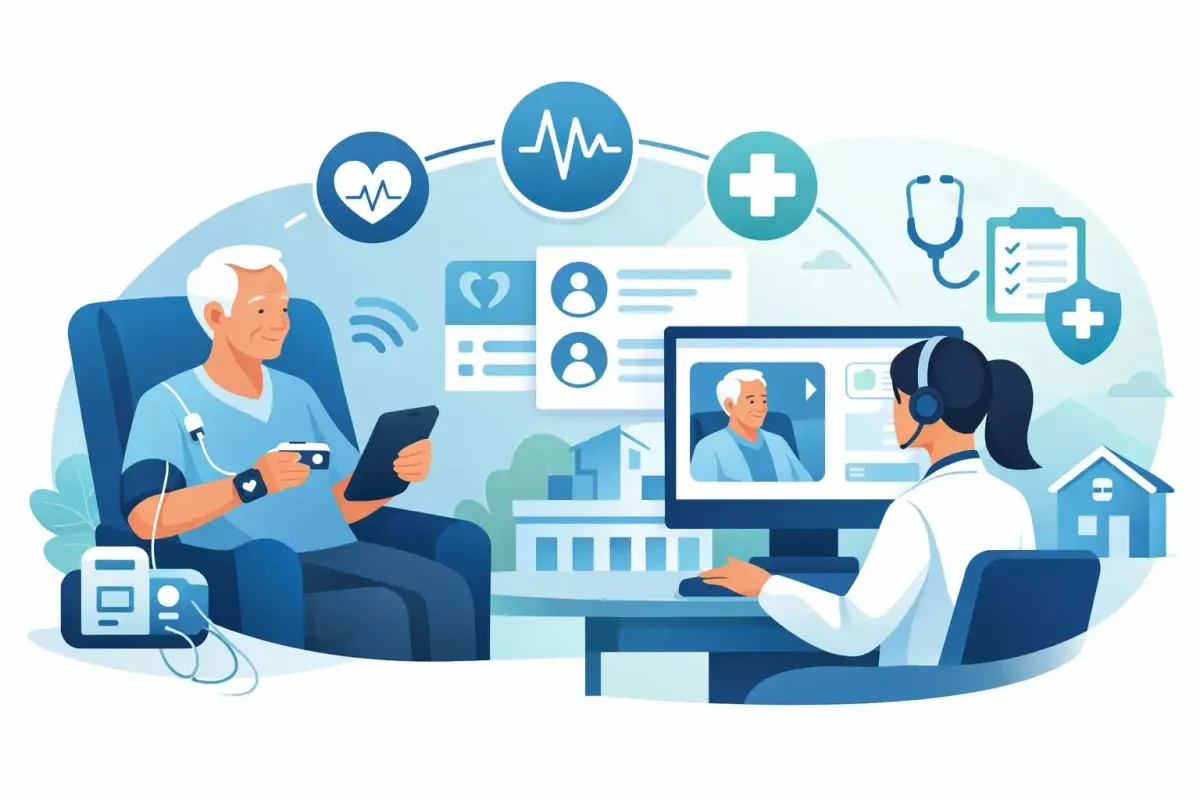
Remote Patient Monitoring (RPM) and Chronic Care Management (CCM) can give practices a structured way to support patients between visits. RPM focuses on collecting physiologic data through connected devices, such as blood pressure cuffs, scales, pulse oximeters, or glucometers. CCM supports ongoing non-face-to-face care coordination for patients with multiple chronic conditions.
The strongest programs integrate these services around the patient rather than treating them as separate billing opportunities. A patient with hypertension, diabetes, heart failure, COPD, or multiple chronic conditions may need device readings, medication reinforcement, outreach after an abnormal trend, and coordinated documentation. A fragmented vendor arrangement creates handoffs. A managed program creates a repeatable care model.
For Medicare-focused organizations, that distinction affects both patient outcomes and financial performance. A service that sends equipment but leaves enrollment, monitoring, documentation, and billing to your team shifts the difficult work back to the practice. A turnkey model assumes responsibility for the operational steps that determine whether a program actually scales.
Clinical data must lead to action
Device data alone has limited value. Blood pressure readings, weight changes, oxygen saturation levels, and glucose trends should be reviewed within a defined workflow, with clinically appropriate escalation pathways and provider oversight. The goal is not to generate more alerts. It is to identify meaningful changes early enough to support intervention.
Ask how the service manages nonadherence, missing readings, abnormal values, and patient questions. High-risk Medicare populations often need practical coaching as much as technology. If a patient cannot pair a device, forgets why daily readings matter, or receives no response after concerning results, engagement drops and clinical value follows.
Billing support must be built into the workflow
RPM and CCM are reimbursable Medicare services when eligibility, consent, time, documentation, device use, and supervision requirements are properly managed. Those requirements are not an administrative afterthought. They are the operating system of a compliant program.
A credible partner should provide clear documentation processes, billing support, audit-ready records, and visibility into program performance. Your practice should understand what is being billed, why it is billable, and where responsibility sits between the clinical team, the service partner, and the rendering provider. Revenue opportunity matters, but it must be supported by disciplined execution.
The program should reduce, not transfer, workload
Many practices have already learned that buying RPM devices is the easy part. The challenge is creating a durable workflow around them. Someone must identify eligible patients, explain the program, obtain consent, ship or distribute devices, provide onboarding, monitor engagement, document monthly activity, coordinate care, and manage billing questions.
Top patient monitoring services take that burden off the front desk, nursing staff, and physicians. They provide the equipment, care specialists, onboarding process, patient outreach, technical support, compliance structure, and account management needed to keep the program moving. This is especially important for organizations managing thin staffing ratios, multiple locations, or a large chronic-care population.
How to Evaluate a Patient Monitoring Partner
The best fit depends on your patient mix, provider capacity, existing care-management capabilities, and growth goals. A small primary care practice may need a fully managed solution because no internal team has capacity to perform monthly outreach. A larger health system may want a partner that works alongside existing population health staff. In either scenario, the evaluation should focus on execution, not sales promises.
Start with patient eligibility and enrollment strategy. A partner should be able to help identify appropriate Medicare patients based on chronic conditions, utilization risk, and clinical need. Enrollment should be presented as part of the patient’s care plan, not as an optional technology experiment. Clear education improves activation and helps patients understand why consistent readings and phone engagement matter.
Then examine the staffing model. Who contacts patients? Are care specialists trained to communicate with older adults and escalate clinical concerns? How are provider instructions incorporated? What happens when a patient becomes unreachable? A program that relies on your existing staff to close every gap may not deliver the low-friction implementation you expected.
Technology still matters, but it should serve the workflow. Confirm that devices are easy for patients to use, data transmission is dependable, and clinicians receive information in a format that supports decisions. More dashboards do not necessarily create better care. The useful system is the one that presents relevant trends, documents interventions, and routes exceptions to the right person at the right time.
Finally, measure financial performance with the same discipline used for clinical performance. Review enrollment volume, activation rates, device adherence, completed monitoring time, CCM engagement, claims activity, remittance patterns, and patient retention. A good partner should provide transparent reporting and help the practice see where program performance can improve.
The Turnkey Model Has a Clear Advantage
For many physician offices, skilled nursing organizations, and assisted living settings, building an internal RPM and CCM operation requires hiring, device procurement, training, protocols, compliance review, and ongoing management. That can delay launch for months and create fixed costs before the first claim is submitted.
A turnkey model changes the economics. With zero equipment cost and zero added staff, the practice can add a reimbursable clinical program while retaining insurance remittances. The service partner manages the operational infrastructure, while the practice maintains clinical oversight and strengthens its ability to serve patients between appointments.
Practice Revenue Solutions delivers this model through FitPeo, a fully managed RPM and CCM program designed for Medicare-serving organizations. The implementation approach is direct: build the workflow around your patient population, provide the necessary equipment and care support, manage enrollment and ongoing engagement, and support compliant reimbursement operations. The objective is not merely to launch a program. It is to create a dependable care and revenue channel that can be up and running in weeks.
That distinction matters because RPM programs often fail at the point of adoption. Devices sit unused. Patients are enrolled without adequate education. Staff lack time for follow-up. Documentation becomes inconsistent. A managed partner addresses those operational failure points before they undermine results.
Questions Worth Asking Before You Commit
Before selecting a service, ask for direct answers about who owns each step of the patient journey. You should know who provides devices, who trains patients, who performs monitoring outreach, who escalates clinical issues, who documents time and activities, and who supports claims submission. Vague answers usually signal that the practice will carry more responsibility than expected.
Also ask how the program protects compliance as it grows. A solution that works for 25 patients must still function at 250 or 2,500 patients. Scalable care requires standardized protocols, trained specialists, quality controls, reporting, and accountability. Growth without operational control creates reimbursement risk and clinician frustration.
The right service should also respect your clinical relationships. Patients should understand that monitoring is an extension of their provider’s care plan. Communications should reinforce trust in the practice, and escalation should fit the provider’s preferences. Outsourcing administrative and engagement work should not mean outsourcing the patient relationship.
A patient monitoring program earns its place when it improves follow-through for vulnerable patients and creates revenue without creating another management problem. Evaluate partners on their ability to execute that promise every month, not just their ability to demonstrate a device. For practices ready to expand Medicare-reimbursed services with minimal disruption, a discovery call can clarify whether a turnkey RPM and CCM model fits the population, workflow, and revenue goals in front of you.
