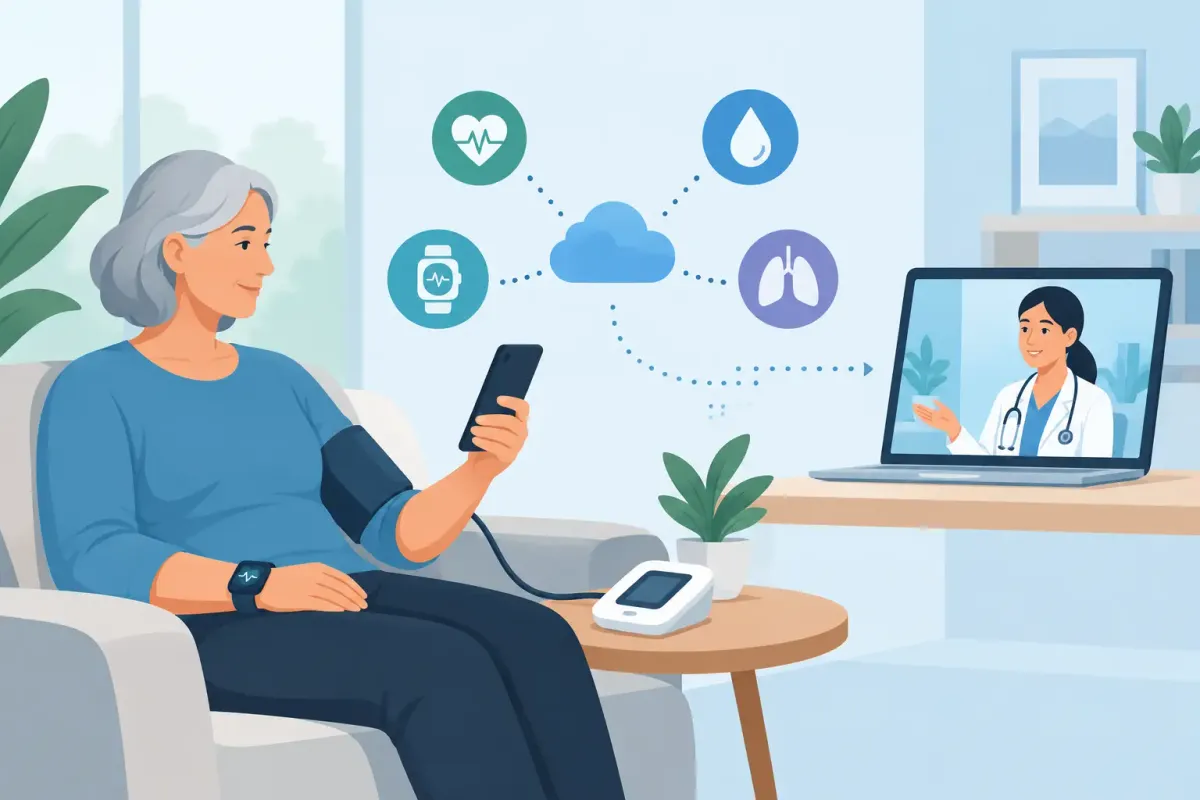
The Future of Remote Patient Monitoring
A patient with uncontrolled hypertension does not become lower risk because their next office visit is 90 days away. The future of remote patient monitoring is being shaped by this simple clinical and financial reality: Medicare populations need consistent oversight between visits, and practices need a practical way to provide it without adding another burden to an already stretched team.
Remote Patient Monitoring, or RPM, is moving beyond the device-first model. A blood pressure cuff, scale, pulse oximeter, or glucose meter is only useful when readings reach the right care team, concerning trends trigger action, documentation supports medical necessity, and billing is handled correctly. The programs that win will not merely collect data. They will turn data into accountable clinical follow-up and sustainable practice revenue.
The Future of Remote Patient Monitoring Is Operational
For many practices, RPM began as a promising reimbursement opportunity that looked difficult to execute. Devices had to be sourced and shipped. Patients needed training. Staff had to monitor data, make outreach calls, document time, coordinate with providers, and submit compliant claims. When those responsibilities land on already busy front-office or clinical teams, enrollment stalls and patient engagement drops.
That is why the next phase of RPM will favor managed implementation over standalone technology. The differentiator is no longer the dashboard. It is the operating model behind it.
A viable RPM program must consistently handle patient identification, consent, device logistics, technical support, clinical monitoring, escalation pathways, provider communication, documentation, and billing workflows. If even one component is weak, the practice absorbs the cost through lost staff time, missed billing opportunities, or patient risk that goes unaddressed.
For a primary care office, the right question is not, "Which RPM platform has the most features?" It is, "Can this program run reliably with our current clinicians, workflows, and compliance obligations?" In skilled nursing, assisted living, and other high-acuity settings, the question becomes even more urgent: Can the program identify change early enough to support intervention before a preventable escalation?
More Data Will Demand Better Clinical Decisions
RPM adoption will continue to expand because chronic disease is not episodic. Hypertension, diabetes, heart failure, COPD, obesity, and other long-term conditions create risk between appointments. Periodic office readings can miss deterioration, nonadherence, and unstable trends that develop at home.
But more readings do not automatically mean better care. A practice can quickly create alert fatigue if thresholds are poorly configured or if no team owns the follow-up process. The future of remote patient monitoring will be defined by selective attention: recognizing which changes warrant outreach, which require a provider decision, and which can be managed through coaching and reinforcement.
Blood pressure is a clear example. An isolated elevated measurement may reflect technique, stress, activity, or a missed medication. A repeated pattern of abnormal readings may indicate that a patient needs medication review, adherence counseling, or more immediate evaluation. The value of RPM is the ability to see that pattern before the next scheduled visit, then document a clinically appropriate response.
This is where a managed care model becomes materially different from a device vendor. Care specialists can support routine patient outreach and data review under defined protocols, while the practice retains clinical oversight. Providers receive meaningful escalations rather than a constant stream of raw information. Patients receive timely contact instead of feeling that a device was mailed to them and forgotten.
Medicare Reimbursement Will Continue to Reward Execution
RPM is not a passive revenue stream. Medicare reimbursement depends on meeting program requirements and maintaining the records to support billed services. Patient eligibility, consent, device use, monitoring time, interactive communication, and provider supervision all require attention. Requirements can change, and payer policies may differ, so practices should use current guidance and confirm the appropriate billing pathway for their situation.
The opportunity remains meaningful because RPM can align patient care with reimbursable work that practices already know is necessary. Chronic disease management requires outreach, medication reinforcement, education, and symptom review. A properly structured RPM program makes that work trackable, documented, and scalable.
The key is to avoid treating reimbursement as separate from care delivery. A program built only around claims volume is vulnerable to poor engagement and compliance gaps. A program built only around clinical aspirations can become an unfunded workload. The strongest model connects both: appropriate patients are enrolled, meaningful data is reviewed, interventions are documented, and claims accurately reflect the services delivered.
For practices serving Medicare populations, this creates a more predictable growth lever than adding another in-office service line that requires capital purchases, new hires, and extensive training. RPM can be implemented with zero equipment cost and zero added staff when an experienced partner manages the operational work. That does not eliminate the practice's responsibility for clinical oversight. It does remove the avoidable friction that keeps many programs from reaching scale.
AI Will Improve Triage, Not Replace Accountability
Artificial intelligence will have a growing role in RPM, particularly in sorting high volumes of readings and identifying patterns that deserve attention. Algorithms can help prioritize patients with persistent out-of-range values, declining adherence, or combinations of changes that suggest a rising risk of hospitalization.
That capability can improve efficiency, but it does not replace clinical judgment. A predictive flag is not a diagnosis. It needs context from the patient's medications, history, symptoms, baseline readings, and care plan. Practices should be cautious about systems that promise fully automated care decisions without clear oversight, transparency, or escalation responsibility.
The practical use of AI in RPM is triage. It can help care teams spend more time on the patients who need outreach now and less time manually sorting routine information. It can also surface enrollment opportunities by identifying patients with chronic conditions, recent utilization, or risk factors that make ongoing monitoring appropriate.
The practices that benefit most will use automation to reduce administrative work, not to distance clinicians from patient care. Technology should make the provider's attention more targeted and timely.
Patient Engagement Will Be the Real Growth Constraint
RPM does not work if devices stay in a box or patients stop transmitting after the first week. The future belongs to programs that treat engagement as an ongoing care responsibility rather than a one-time onboarding task.
That begins with selecting patients who are clinically appropriate and likely to benefit. A patient with uncontrolled hypertension, frequent medication changes, recent hospitalization, or difficulty attending appointments may be an excellent candidate. A stable patient who does not understand the purpose of monitoring may need more education before enrollment is worthwhile.
Simple onboarding matters. Patients need to know how to use the device, how often to take readings, what the care team will do with the information, and whom to call for support. They also need follow-up. When patients see that someone responds to their data, participation becomes more credible. When there is no contact, RPM can feel like another disconnected healthcare task.
Language access, digital comfort, cognitive limitations, and caregiver involvement also affect success. There is no one-size-fits-all enrollment script. Long-term care settings may need a workflow built around facility staff, while an independent older adult may need device support and periodic coaching. A strong program adapts without forcing the practice to build a separate process for every population.
What Healthcare Leaders Should Build Now
Leaders evaluating RPM should start with operational readiness, not a technology demo. Identify the patient cohorts where monitoring can support care goals and where reimbursements can justify a sustained program. Then define who handles enrollment, device distribution, monitoring, escalation, documentation, and billing.
A practical RPM partner should be able to explain those responsibilities in plain terms. Ask whether the program provides devices, patient onboarding, care specialists, compliance infrastructure, billing support, and ongoing account management. Ask what happens when a patient does not transmit, when an alert requires escalation, and when documentation is incomplete. Those details determine whether the program creates a revenue stream or another management problem.
Implementation speed matters as well. A well-designed managed program can be up and running in weeks, but speed should not mean cutting corners on protocols, provider alignment, or staff communication. The goal is a workflow that feels integrated from day one, not a new initiative that depends on a few motivated employees to keep it alive.
Practice Revenue Solutions approaches RPM as a managed clinical program, not a device sale. The most effective deployments give practices the ability to expand patient oversight and pursue reimbursable services while protecting their teams from equipment costs, staffing burdens, and administrative complexity.
The next patient whose readings begin to trend in the wrong direction should not have to wait for the next appointment to be seen. Build the monitoring process now, with clear ownership and clinical discipline, so timely intervention becomes part of everyday care rather than an exception.
